

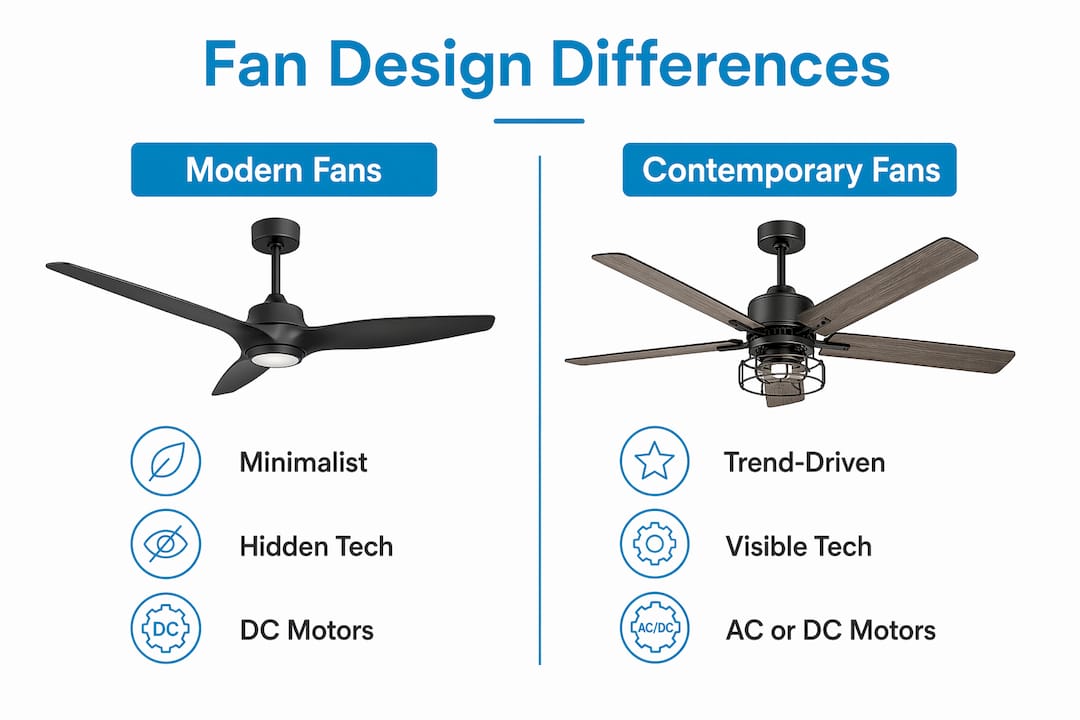
Modern vs contemporary fan design describes two distinct ceiling fan categories separated by design philosophy, materials, and how technology is expressed visually. Modern fans commit to a fixed aesthetic rooted in minimalism, clean geometry, and hidden technology. Contemporary fans chase current trends, meaning their look shifts with interior design movements and treats technology as a visible feature. Understanding this difference saves you from buying a fan that fights your room instead of finishing it. Both styles can perform beautifully, but they serve different rooms, different personalities, and different design goals.
What sets modern vs contemporary fan design apart
Modern ceiling fan design is a fixed style category, not a moving target. It draws from the mid-20th century modernist movement, which valued function, simplicity, and the elimination of decorative excess. A modern fan looks the same whether you buy it in 2018 or 2026 because its principles do not change with trends.
Contemporary design, by contrast, is defined by right now. The word “contemporary” literally means “of the present time,” which is why contemporary decor shifts with each design cycle. A contemporary fan from 2020 may look dated by 2026, while a modern fan from the same year still reads as intentional and current.
This is the core distinction most buyers miss. They use the two words interchangeably, then wonder why a fan feels out of place in a room they carefully designed. Modern fans belong in spaces built around permanence and restraint. Contemporary fans belong in spaces that evolve with trends and make a visual statement.
What characterizes modern ceiling fan styles
Modern ceiling fan styles are defined by three principles: minimal ornamentation, geometric precision, and concealed technology.
The typical modern fan uses three to five blades in flat or slightly angled profiles. Finishes run toward matte black, brushed nickel, and flat white. Materials like ABS plastics and solid paulownia wood blades are common because they hold clean lines without visual noise. Low-profile or hugger configurations suit the standard 8-foot ceilings found in most American homes.
The technology inside a modern fan is just as deliberate as the exterior. DC motors save up to 70% in electricity compared to traditional AC motors and offer up to six speed settings. That efficiency matters for rooms where the fan runs daily. Modern fans also integrate LED lighting with adjustable CCT tunings from 3000K to 6000K and dimmable brightness from 10% to 100%, so the light serves the room without demanding attention.
Key features you will find in modern ceiling fan styles:
-
Matte or brushed finishes with no decorative hardware
-
Three to five blades in flat geometric profiles
-
DC motors with multiple speed settings
-
Integrated LED lighting with color temperature control
-
Remote or wall control with discreet receivers
-
Low-profile mounting for standard ceiling heights
Pro Tip: If you want a modern fan’s technology without sacrificing the clean look, choose a model where the remote receiver is hidden inside the canopy. Visible receivers on the motor housing break the minimalist silhouette.
What defines contemporary fan features and trends
Contemporary ceiling fans are the design world’s response to the moment. They borrow from whatever interior style is dominant right now, whether that is warm minimalism, biophilic design, or bold sculptural forms. This makes them more expressive than modern fans but also more time-sensitive.
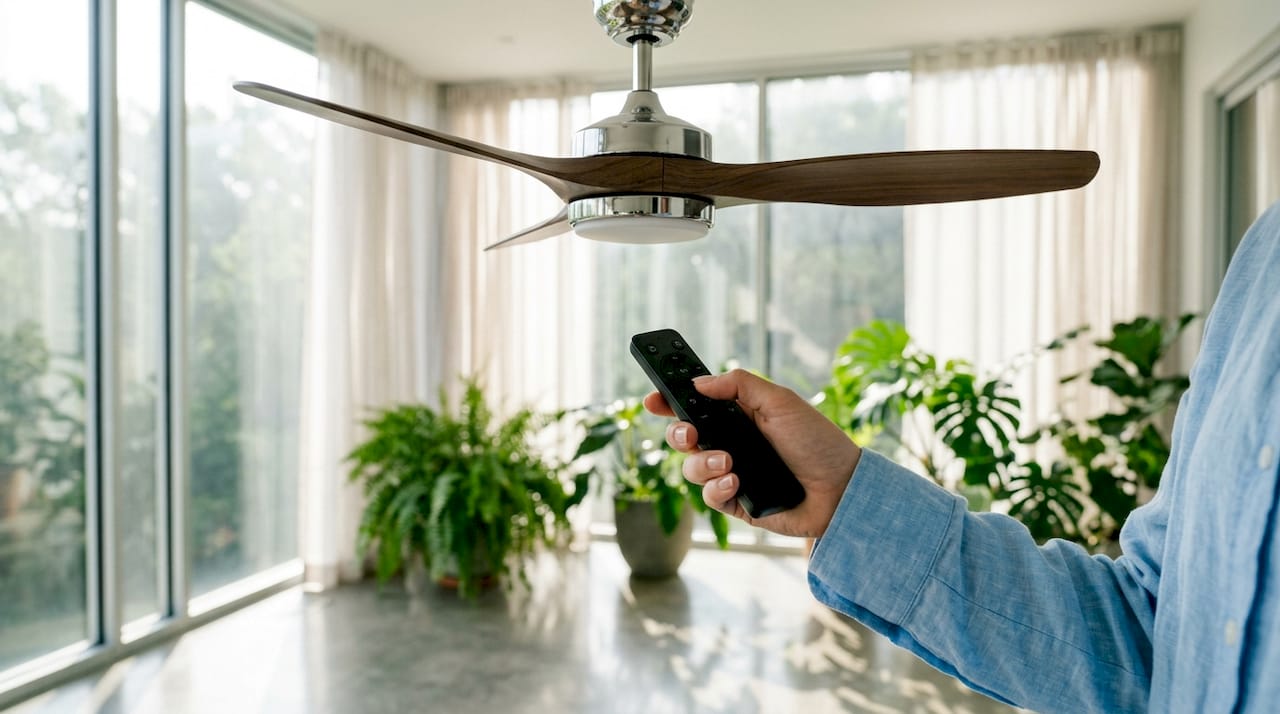
Where a modern fan hides its technology, a contemporary fan often showcases it. Smart home compatibility is treated as a visible feature in contemporary designs, with app controls, voice commands, and color-changing LED rings presented as part of the fan’s identity rather than tucked away. The Kathy Ireland HOME 56-Inch Euclid fan is a strong example: reversible blades, integrated LED lighting, and remote operation are all front-facing design decisions, not afterthoughts.
Contemporary fans also use mixed materials more freely. You will find combinations of metal and wood, matte and gloss finishes on the same unit, or blade shapes that reference natural forms like leaves or wings. These choices make the fan an architectural statement rather than a background element.
Defining features of contemporary fan design trends:
-
Mixed materials and contrasting finishes on a single unit
-
Sculptural or organic blade shapes
-
Technology presented as a visible design element
-
Alignment with current interior color palettes and textures
-
Larger blade spans for dramatic visual presence
-
Frequent updates to finish options as trends shift
Pro Tip: Before buying a contemporary fan, pull up the room’s dominant finish and material palette. Contemporary fans work best when at least two of their materials echo something already in the space, like a wood blade tone that matches your flooring.
How do modern and contemporary fans compare in performance?
Style is only half the decision. Performance determines whether a fan actually improves your comfort or just looks good in a photo.
Consumer Reports lab testing ranks ceiling fans by airflow, noise at various speeds, and overall adjustability. Their 2026 testing found only a few models rated excellent overall. That result matters because it separates style-driven expectations from real comfort benefits. A sculptural contemporary fan with a weak motor will move less air than a plain modern fan with a quality DC motor.
Blade count is the most misunderstood performance variable. Consumer Reports advises choosing blade count for style, not comfort or efficiency. Airflow and noise depend on motor type and blade pitch, not the number of blades. A three-blade modern fan with a DC motor will outperform a five-blade decorative fan with a weak AC motor every time.
| Feature | Modern Fan Design | Contemporary Fan Design |
|---|---|---|
| Motor type | DC motor standard | AC or DC, varies by model |
| Speed settings | Up to 6 speeds | Typically 3 speeds |
| Control method | Remote or wall control, discreet | App, voice, remote, showcased |
| LED lighting | Adjustable CCT, dimmable | Color-changing or accent lighting |
| Noise level | Low, optimized for daily use | Varies by motor and blade design |
| Energy efficiency | High, up to 70% savings | Moderate to high |
Smart control features like voice commands and adjustable color temperature LEDs appear in both categories, but the difference is presentation. Modern fans hide the receiver and keep the interface minimal. Contemporary fans display the technology as part of the design story.
For rooms where the fan runs six or more hours daily, the DC motor advantage in modern fans translates to real savings on your electricity bill. For rooms where the fan runs occasionally and visual impact matters more, a contemporary model with a standard AC motor is a reasonable trade-off.
Which fan style fits your home and preferences?
Choosing between modern and contemporary ceiling fan styles comes down to three factors: your room’s existing design language, your ceiling height, and how long you want the fan to feel current.
Matching fan finishes and blade materials to room elements like ceiling color or furniture wood tones makes the fan read as part of the room’s composition rather than an addition to it. This principle applies to both styles, but it plays out differently. A modern fan in matte black should echo the matte black hardware elsewhere in the room. A contemporary fan with mixed wood and metal should reference both materials already present in the space.
Consider these factors when deciding:
-
Ceiling height: Modern low-profile fans suit 8-foot ceilings. Contemporary fans with longer downrods work better in rooms with 9-foot or higher ceilings.
-
Room longevity: If you are designing a room you plan to keep for ten or more years, a modern fan’s fixed aesthetic ages better. A contemporary fan may need replacing when the trend it references fades.
-
Tech preferences: If you use Alexa, Google Home, or Apple HomeKit, verify compatibility before buying. Both styles offer smart options, but not every model in either category includes them.
-
Maintenance: Matte finishes on modern fans show fingerprints less than high-gloss contemporary finishes. Mixed-material contemporary fans may require more careful cleaning around joints and seams.
For living room ceiling fan selections specifically, the room’s focal point matters. If the fan is the room’s centerpiece, a contemporary sculptural model earns that position. If the fan should disappear into a well-designed room, a modern minimalist fan is the right call.
You can also explore transitional style fans if your room blends traditional and modern elements. Transitional fans borrow from both categories and work in spaces that do not commit fully to either direction.
Key takeaways
Modern fans deliver fixed minimalist aesthetics and DC motor efficiency, while contemporary fans prioritize trend-driven expression and visible technology integration.
| Point | Details |
|---|---|
| Design philosophy differs | Modern is fixed and minimalist; contemporary shifts with current trends. |
| DC motors favor modern fans | Modern fans with DC motors save up to 70% electricity versus traditional AC motors. |
| Blade count is aesthetic only | Choose blade count for looks, not airflow; motor type determines real performance. |
| Match materials to the room | Echo fan finishes and blade tones in existing furniture and ceiling colors. |
| Contemporary fans age faster | A contemporary fan tied to a specific trend may feel dated sooner than a modern design. |
The honest truth about fan style choices
I have spent years watching homeowners agonize over fan style, then install the wrong one because they confused “modern” with “new.” The two words are not synonyms. A fan released last month can be traditional. A fan designed in 1965 can still read as modern today.
The mistake I see most often is buying a contemporary fan for a room that was designed to last. Contemporary fans are genuinely beautiful, but they carry a built-in expiration date. When the design trend they reference moves on, the fan can feel like a relic. Modern fans do not have that problem because their aesthetic is not tied to a moment.
That said, I would not dismiss contemporary fans. In the right room, a sculptural contemporary fan with mixed materials and visible smart controls is the most interesting object in the space. It earns attention. The question is whether you want your fan to earn attention or earn its keep quietly.
My honest recommendation: if you are renovating a room you plan to live in for a decade, go modern. If you are staging a property, designing a short-term rental, or building a room around a specific current aesthetic, a contemporary fan gives you more expressive range. Either way, do not skip the DC motor efficiency conversation. A beautiful fan that costs you extra every month on your electric bill is a bad trade.
— Eli
Find your style at Wynwood Fans

Wynwood Fans carries both modern and contemporary ceiling fans designed for real homes, not just showrooms. The 52in CAPTIVA LED 3 Blade Ceiling Fan in Matte Black is a strong example of modern fan aesthetics done right: three-blade minimalist profile, integrated LED lighting, and a clean finish that works in almost any room. For a contemporary statement, the Kathy Ireland HOME 56-Inch Euclid delivers reversible blades, integrated lighting, and remote operation in a design that commands attention. Both models reflect the energy-efficient and style-forward direction Wynwood Fans builds toward.
FAQ
What is the main difference between modern and contemporary fans?
Modern fans follow a fixed minimalist design philosophy rooted in clean lines and hidden technology. Contemporary fans reflect current design trends and treat technology as a visible feature, making them more expressive but more time-sensitive.
Do modern or contemporary fans perform better?
Performance depends on motor type and blade pitch, not style category. Modern fans more commonly use DC motors, which save up to 70% electricity compared to AC motors, giving them a consistent efficiency advantage.
Does blade count affect airflow in ceiling fans?
No. Consumer Reports confirms that blade count is an aesthetic choice. Airflow and noise levels depend on motor quality and blade pitch, not the number of blades.
Which fan style works best in a small room?
Modern fans with low-profile or hugger mounting configurations suit smaller rooms and standard 8-foot ceilings better. Their compact geometry does not overwhelm the space the way a large contemporary sculptural fan might.
Can a ceiling fan work with smart home systems?
Yes. Both modern and contemporary fans offer smart home compatibility, including app and voice control. Modern fans tend to conceal the technology, while contemporary fans present it as part of the design. Always verify compatibility with Alexa, Google Home, or Apple HomeKit before purchasing.