

The AC vs DC ceiling fan differences come down to one thing: the type of motor inside the housing, and that single distinction drives everything from your electricity bill to how quietly you sleep. AC fans run on alternating current directly from your home’s wiring. DC fans convert that current into direct current through an internal rectifier, powering a brushless motor that operates with far greater precision. The result is a meaningful split in performance, cost, and installation complexity. Knowing which motor type fits your home, wiring, and budget is the decision this guide is built to help you make.
What are the main technical differences between AC and DC ceiling fan motors?
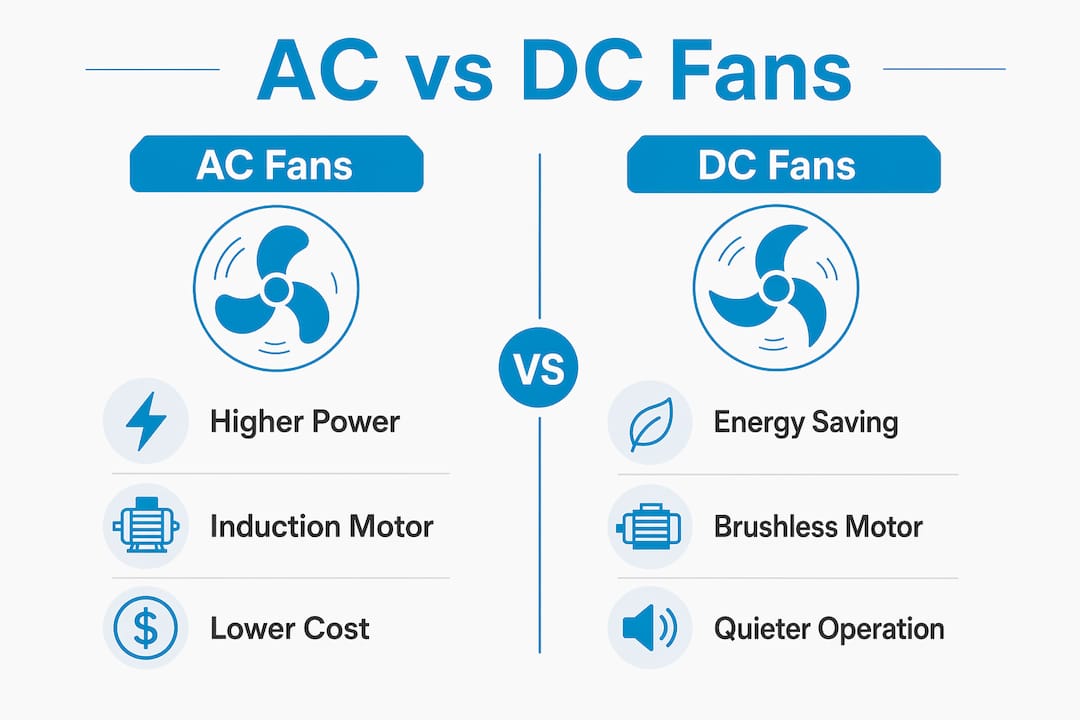
AC ceiling fans use induction motors, a technology that has been standard in residential fans for decades. These motors are simple, proven, and require no internal electronics to convert power. They spin at fixed speeds tied to the frequency of your home’s electrical current, which is why most AC fans offer only three or four speed settings. The motor itself is relatively large and heavy, which limits how slim or lightweight the fan’s design can be.
DC fans use brushless DC motors powered by an internal circuit board that converts AC power from your wall into direct current. This conversion process gives the motor precise speed control and far greater torque relative to its size. Higher torque in DC motors allows for steeper blade pitches, often exceeding 14 degrees, which moves more air at lower speeds. That combination of steep pitch and low RPM is why DC fans feel so effective even when running quietly.
The size difference between the two motor types has a direct impact on design. DC motors are compact and light, which lets manufacturers create thinner profiles, longer blade spans, and more sculptural shapes. Wynwoodfans leverages this advantage across its modern and coastal collections, where the motor housing is barely visible within the fan’s overall silhouette.
-
AC motors: Fixed speed increments, larger housing, no internal electronics, straightforward wiring
-
DC brushless motors: Variable speed control, compact size, internal PCB, quieter operation at low RPM
-
Blade pitch: DC motors support steeper pitches for better airflow at lower speeds
-
Noise: AC fans generate more noise and motor hum, especially at high speeds, while DC fans operate nearly silently at low RPMs
Pro Tip: If you plan to use a ceiling fan in a bedroom or home office, the noise difference between AC and DC motors is not subtle. Run a DC fan on speed two and most people cannot tell it is on.
How do AC and DC ceiling fans compare in energy efficiency and operating cost?
This is where the DC ceiling fan advantages become impossible to ignore. DC fans use 70 to 75% less electricity than AC models, drawing between 5 and 35 watts compared to 60 to 100 watts for AC fans running on high speed. That gap is not a rounding error. It means a DC fan running eight hours a day costs a fraction of what an AC fan costs over the same period.
| Feature | AC Ceiling Fan | DC Ceiling Fan |
|---|---|---|
| Power draw (high speed) | 60 to 100 watts | 5 to 35 watts |
| Estimated energy savings | Baseline | Up to 70 to 75% less |
| Speed settings | 3 to 4 | 5 to 6 or more |
| Annual operating cost (est.) | Higher | Significantly lower |
| Best for energy savings | No | Yes |
To put those numbers in practical terms: if you run three AC fans at 80 watts each for 10 hours a day, you consume 2.4 kilowatt-hours daily. Replace them with DC fans drawing 20 watts each, and that drops to 0.6 kilowatt-hours. Over a year, that difference adds up to real money on your utility bill, especially in warmer climates where fans run year-round.
The environmental case for DC fans follows directly from the efficiency numbers. Lower wattage means less demand on the grid, which reduces carbon output from power generation. For homeowners pursuing LEED certification or simply trying to lower their household footprint, DC fans are the straightforward choice.
One nuance worth noting: the energy savings only materialize if you actually use the fan’s lower speed settings. DC fans are most efficient at speeds two through four. Running a DC fan on maximum speed still draws less power than an AC fan, but the gap narrows. The AC vs DC fan energy efficiency advantage is most dramatic in everyday moderate use, not at full throttle.
What are the installation and control differences between AC and DC fans?
One of the biggest misconceptions about DC ceiling fans is that they are more difficult to install than traditional AC fans. While some older DC fan designs required additional wiring considerations, most modern DC fans use a low-voltage receiver system that makes installation virtually identical to a standard ceiling fan with a remote control.
For example, Wynwood Fans DC motor models utilize a low-voltage receiver installed in the fan canopy. This receiver converts household power for the DC motor and communicates with the included remote control. As a result, installation typically requires the same wiring found in most homes:
-
Black (hot) wire
-
White (neutral) wire
-
Ground wire
No additional control wires or special switch-leg wiring are required. In most cases, if your home can accommodate a standard ceiling fan with a remote control, it can accommodate a modern DC ceiling fan as well.
Where DC fans truly distinguish themselves is in the user experience and performance. Compared to traditional AC motor fans, DC fans offer several advantages:
-
Speed options: Most DC fans provide six or more speed settings, allowing for finer airflow adjustments. Instead of large jumps between speeds, airflow changes are smooth and precise.
-
Remote control: DC fans typically include a full-function remote control that manages fan speed, lighting, timers, and direction changes from anywhere in the room.
-
Reverse function: Rather than climbing a ladder to flip a switch on the motor housing, DC fans allow users to reverse airflow electronically using the remote control. Switching between summer and winter operation takes only seconds.
-
Smart home integration: Many modern DC fans, including select Wynwood Fans models, can integrate with smart home systems such as Amazon Alexa and Google Home, enabling voice control, scheduling, and app-based operation.
Pro Tip: Before purchasing any ceiling fan, verify that your ceiling outlet box is rated to support a fan. For most homeowners, the installation process for a modern DC fan with a low-voltage receiver is the same as installing a traditional remote-controlled AC ceiling fan.
How do cost and design aesthetics factor into the AC vs DC decision?
Historically, DC ceiling fans carried a substantial price premium over traditional AC fans. Early DC motor technology was typically reserved for high-end designer fans, often costing several hundred dollars more than comparable AC models.
Today, that gap has narrowed dramatically.
Advances in motor technology, manufacturing efficiencies, and modern low-voltage control systems have made DC fans far more affordable than they were a decade ago. Many quality DC fans are now available at price points that compete directly with mid-range AC fans.
For example, DC ceiling fans can be found in a wide range of price categories, from entry-level models under $100 to premium designer fans exceeding $300. Wynwood Fans offers several DC motor models ranging from approximately $89 to under $300, demonstrating that energy-efficient DC technology is no longer limited to luxury budgets.
While price differences still exist between specific models and feature sets, shoppers should evaluate fans based on overall value rather than motor type alone. Features such as blade design, lighting options, smart controls, airflow performance, warranty coverage, and energy efficiency often have a greater impact on price than whether the motor is AC or DC.
Where DC fans continue to provide an advantage is long-term operating efficiency. DC motors typically consume less electricity, run quieter, and offer more speed settings than traditional AC motors. For homeowners who use ceiling fans regularly, these benefits can contribute to lower energy consumption and improved comfort over the life of the fan.
The bottom line: choosing between AC and DC is no longer primarily a budget decision. Modern DC fans are available across a broad range of price points, giving homeowners access to advanced features and energy-efficient performance without the premium pricing that once defined the category.
Design is the other dimension where DC fans pull ahead. The compact motor housing opens up possibilities that simply do not exist with bulkier AC motors.
-
Slim profiles: DC fans can achieve blade-to-ceiling gaps under four inches, ideal for rooms with eight-foot ceilings
-
Longer blade spans: The lighter motor allows larger blade spans without structural stress on the mounting bracket
-
Modern aesthetics: DC fans’ smaller motors enable sleek designs favored in contemporary and coastal home decor
-
Bedroom suitability: Near-silent operation at low speeds makes DC fans the clear choice for sleeping spaces
AC fans are not without their strengths. They are simple, durable, and widely available. For a garage, workshop, or utility room where aesthetics are irrelevant and budget is tight, an AC fan is a perfectly rational choice. The Kathy Ireland HOME 44" Connie fan is a good example of an AC-motor model that still delivers solid performance and a polished look at an accessible price at $69.99.
Which fan type is better for different rooms and use cases?
The right motor type depends on where the fan lives and what you need it to do. There is no universal answer, but the use cases are fairly clear once you map them out.
DC fans are the better fit when:
-
The room is a bedroom, nursery, or home office where noise matters
-
You want smart home integration with Google Home, Amazon Alexa, or a dedicated app
-
Energy savings are a priority and the fan will run for long hours daily
-
The design needs to complement a modern, coastal, or minimalist interior
-
You are installing in a new construction home with updated wiring that includes a neutral wire
-
The 52-inch Biscayne DC fan with six-speed remote control is a strong example of this category
AC fans are the better fit when:
-
Budget is the primary constraint and the room is a utility or secondary space
-
The home has older two-wire wiring and you want to avoid electrical work
-
The installation is in a garage, workshop, or covered porch where simplicity wins
-
You need a straightforward replacement with no learning curve
One factor that applies to both motor types: if the fan is going outdoors or into a humid space like a bathroom or covered lanai, check the UL rating. CE and UL Damp or Wet ratings are critical for DC fan durability in humid or outdoor environments, because moisture can damage the internal circuit board. An unrated DC fan in a damp location will fail far sooner than a properly rated AC fan in the same spot. Always match the fan’s environmental rating to the installation location, regardless of motor type.
Blade size and pitch matter alongside motor type. A DC motor with a 52-inch blade span and a 14-degree pitch will outperform a DC motor with a 42-inch span and a shallow pitch in the same room. Motor type sets the ceiling on performance; blade geometry determines how close you get to it.
Key takeaways
DC ceiling fans cost more upfront but deliver 70 to 75% energy savings, quieter operation, and more design flexibility than AC fans, making them the better long-term investment for most living spaces.
| Point | Details |
|---|---|
| Energy savings are substantial | DC fans draw 5 to 35 watts versus 60 to 100 watts for AC, cutting energy use by up to 75%. |
| Installation complexity differs | DC fans often need a neutral wire; older homes may require electrical work before installation. |
| Design freedom favors DC | Compact DC motors enable slimmer profiles and longer blade spans suited to modern interiors. |
| AC fans win on upfront cost | At $50 to $150, AC fans are the practical choice for utility spaces and tight budgets. |
| Environmental ratings matter | Always match UL Damp or Wet ratings to the installation location, especially for DC fans outdoors. |
Why I started recommending DC fans for main living spaces
I have helped a lot of homeowners work through this decision, and the pattern I keep seeing is the same: people buy an AC fan to save money upfront, then replace it within five years because it is too loud for the bedroom or too inefficient for a room that runs 12 hours a day in summer. The math on DC fans used to look expensive at the register and obvious in hindsight, but this is no longer the case.
The installation was a concern but now overstated. A DC fan installs in about the same time as an AC model using the same connections that older homes have. The cases where you genuinely needed an electrician to run an extra neutral wire for the original DC technology for the older homes with knob-and-tube or early two-wire setups are long gone.
Next, DC motors are just quieter. Period.
Last plug... one thing I would add that most buying guides skip: pay attention to the warranty terms on ALL fans. Most of the brands that you cannot even pronounce in the A to Z marketplace do not carry a listed safety certification, overstate their performance data, and do not have standard brackets highlighting a safety issue in most cases. The internal electronics are the vulnerability. A DC fan with a two-year warranty on the motor and electronics is a different product than one with a limited lifetime motor warranty. Wynwood Fan Company backs its models with strong warranty coverage, which matters when you are spending any money on a single fixture.
— Eli
Find the right fan for your space at wynwoodfans.com

Wynwood Fan Company carries both AC and DC ceiling fans across every major style category, from coastal and modern to farmhouse and industrial. If you are ready to make the switch to DC motor technology, the 52-inch Yonas Coastal Grade fan combines energy-efficient DC motor performance with a UL-rated build designed for humid and outdoor environments. For larger rooms, the 60-inch Edgewater DC fan delivers six-speed remote control, dimmable LED lighting, and reversible airflow in a matte black finish that works in almost any interior. Browse the full collection at Wynwoodfans.com to filter by motor type, room size, and style.
FAQ
What is the main difference between AC and DC ceiling fans?
The core difference is the motor type. AC fans use induction motors powered directly by alternating current, while DC fans use brushless motors powered by converted direct current, resulting in significantly lower energy consumption and quieter operation.
Are DC ceiling fans worth the higher price?
For rooms used daily, yes. DC fans use up to 75% less electricity than AC models, and their brushless motors last longer with less heat buildup, making the higher upfront cost recoverable within three to five years of regular use.
Can I install a DC ceiling fan in an older home?
Often yes, but check first. DC fans frequently require a neutral wire at the switch box to power their internal electronics. Homes built before the 1990s may need an electrician to add one before installation.
Which ceiling fan type is quieter?
DC fans are significantly quieter. AC fans generate motor hum at high speeds, while DC fans operate nearly silently at low and medium speeds, making them the preferred choice for bedrooms and offices.
Do DC ceiling fans work outdoors?
Yes, but only models with a UL Damp or Wet rating. The internal circuit board in DC fans is vulnerable to moisture damage, so an environmental rating is not optional for covered patios, lanais, or any humid installation.