

A transitional style ceiling fan is defined as a fixture that blends traditional elegance with contemporary simplicity, creating a design that fits comfortably in a wide range of home interiors without committing to either extreme. These fans draw from classic silhouettes — think five-blade sweeps and warm wood tones — while pairing them with clean motor housings, neutral finishes, and minimal ornamentation. The result is a ceiling fan that works in a craftsman bungalow just as naturally as it does in a new-construction open-plan living room. If you have ever stood in a showroom unable to decide between a rustic farmhouse fan and a sleek modern one, a transitional fan is almost certainly the answer.
What visual design features characterize transitional ceiling fans?
Transitional style is defined in interior design as the perfect blend of classic and modern, achieved through balance and versatile neutral palettes rather than heavy ornamentation. For ceiling fans, that definition translates into a specific set of visual cues that set this category apart from both traditional and contemporary models.
The motor housing is the first giveaway. Transitional fans use sleek, uncluttered housings without the scrollwork or ornate casting you find on traditional chandeliers or the aggressively geometric shapes of ultra-modern fans. Finishes like brushed nickel, matte black, antique pewter, and oil-rubbed bronze dominate this category because they read as both timeless and current depending on the surrounding decor.
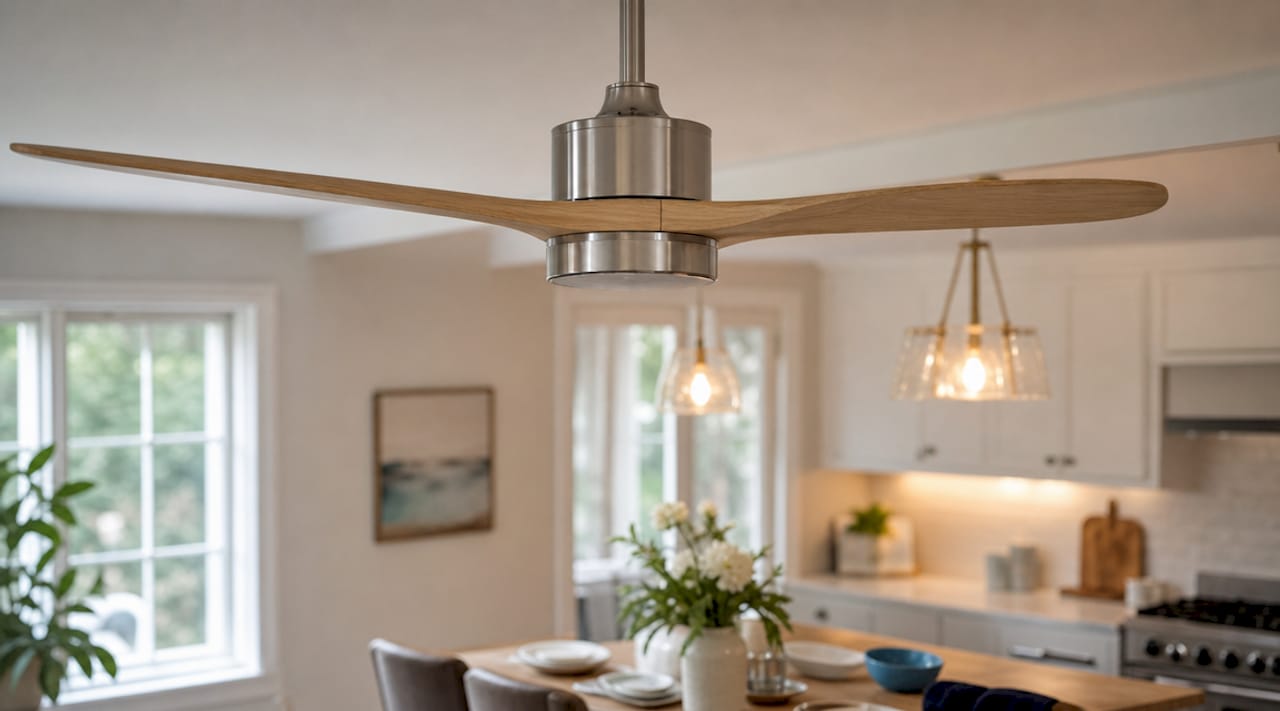
Blade design is where the real craft shows. Brushed nickel housings paired with weathered wood blades are a signature combination because the contrast between cool metal and warm wood captures the transitional balance in a single fixture. Reversible blades take this further, offering two finishes in one fan. A blade that is light maple on one side and dark walnut on the other gives you genuine flexibility without buying a second fan.
Here is what separates a well-executed transitional fan from one that simply looks confused:
- Blade shape: Classic sweeps with a slight pitch, not razor-thin modern paddles or heavily carved traditional profiles
- Finish coordination: Motor housing and blade finish share at least one tonal family, such as warm bronze with warm wood, or cool nickel with gray-washed blades
- Decorative restraint: Subtle details like a simple canopy trim or a clean light kit bezel, never medallions or heavy casting
- Color palette: Neutral and grounded. Matte black, antique pewter, and oil-rubbed bronze are the most common motor finishes in this category
- Material mix: Wood and metal combinations signal transitional intent more reliably than any single material alone
Pro Tip: When evaluating a fan in a showroom or online, cover the blades and assess the housing alone. If it reads as neither aggressively modern nor overtly traditional, you are looking at a transitional motor housing. Then check whether the blades reinforce or contradict that impression.
Transitional decor succeeds when it is elegant without fuss, using fewer but more intentional decorative references. The same principle applies to fans. A single well-chosen detail, like a brushed nickel canopy with a subtle lip, does more for the transitional aesthetic than three competing decorative elements.
How to choose the right size and placement for a transitional ceiling fan
Size is the most consequential decision you will make when selecting any ceiling fan, and it is the one most homeowners get wrong. A fan that is too small for the room looks like an afterthought. One that is too large overwhelms the space and creates visual imbalance that no finish or blade style can fix.
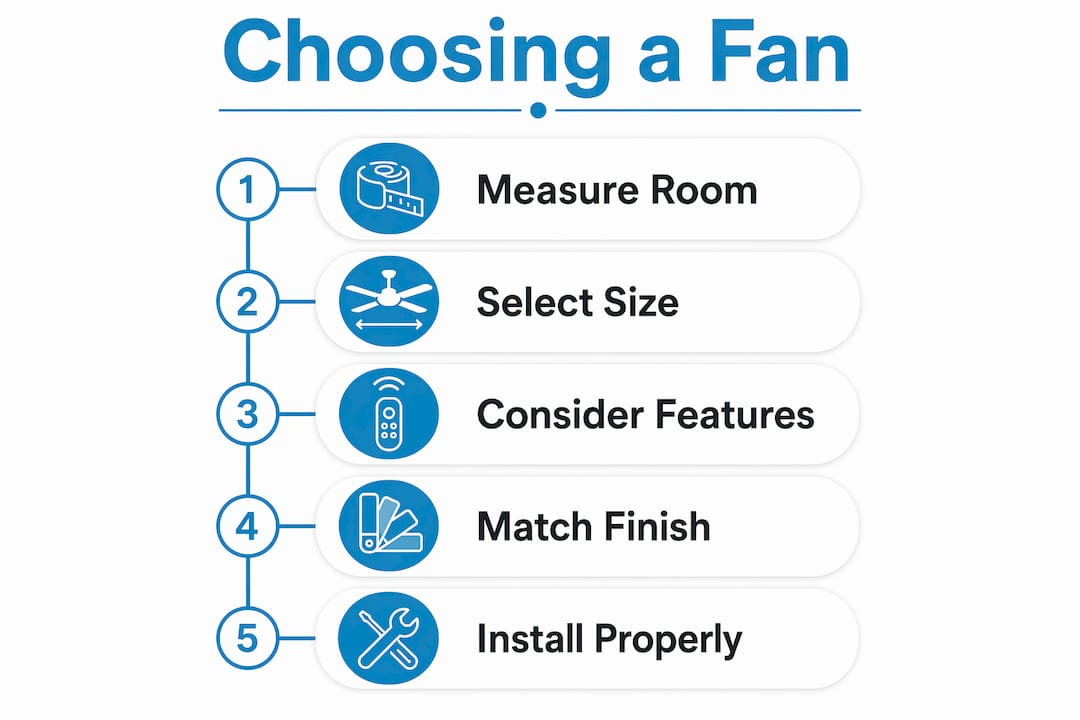
Follow this sizing framework before comparing any features or finishes:
- Measure your room’s square footage. Multiply length by width. A 12 x 14 ft room is 168 square feet.
- Match blade span to room size. Rooms under 75 sq ft work with fans up to 36 inches. Rooms between 75 and 175 sq ft suit 42 to 48-inch fans. Standard rooms between 175 and 350 sq ft call for 52-inch blade spans. Rooms over 350 sq ft need 54 inches or larger.
- Assess your ceiling height. The blade should sit between 8 and 9 feet from the floor for optimal airflow and visual proportion. This is the blade clearance sweet spot that most installation guides converge on.
- Choose your mounting type. Ceilings at 8 feet or under call for a flush mount, also called a hugger mount. Ceilings between 9 and 10 feet work with a short downrod. Ceilings above 10 feet need a longer downrod to bring the blades into the effective airflow zone.
- Account for clearance from walls. Blade tips should sit at least 18 inches from any wall or obstruction to prevent turbulence and noise.
| Room size | Recommended blade span | Mounting type |
|---|---|---|
| Under 75 sq ft | Up to 36 inches | Flush mount |
| 75 to 175 sq ft | 42 to 48 inches | Flush or short downrod |
| 175 to 350 sq ft | 52 inches | Downrod standard |
| Over 350 sq ft | 54 inches or larger | Extended downrod |
Sizing mistakes affect both airflow performance and visual appeal, which is why measuring accurately before comparing finishes is the correct sequence. Most homeowners reverse this order, falling in love with a finish before confirming the size works for their room.
Pro Tip: For rooms with sloped or vaulted ceilings, use an angled mounting adapter rather than a standard downrod bracket. Without it, the fan hangs at an angle, reducing airflow efficiency and creating an obvious visual tilt that no amount of styling corrects.
What modern features and functional benefits do transitional ceiling fans offer?
Transitional fans are not just about aesthetics. The best models in this category carry technology that justifies the price point and delivers measurable comfort and efficiency improvements.
DC motors, remote controls, and smart home compatibility are now standard features in quality transitional fans, allowing precise speed and lighting adjustments that improve both comfort and energy efficiency. DC motors in particular use significantly less electricity than AC motors while running quieter, which matters in bedrooms and home offices where fan noise is noticeable.
The functional feature list for a well-specified transitional fan includes:
- DC motor technology: Quieter operation, more speed settings (often six or more versus the standard three), and lower energy draw than AC motors
- ENERGY STAR certification and Title 24 JA8 compliance: These energy-saving certifications confirm that both the motor and lighting system meet efficiency standards, which matters for utility costs and California building code compliance
- Integrated LED lighting: Dimmable LED light kits built into the fan housing eliminate the need for a separate fixture, reducing ceiling clutter and energy use simultaneously
- Smart home compatibility: Wi-Fi or Bluetooth-enabled fans connect to Amazon Alexa, Google Home, or Apple HomeKit for voice and app control
- Reversible blades: Seasonal blade reversal pushes warm air down in winter and creates a cooling downdraft in summer, improving year-round comfort without changing the thermostat setting
- Remote control: A handheld or wall-mounted remote allows speed and light adjustment without a dedicated wiring run for a separate dimmer switch
The Kathy Ireland HOME Lindell 52-inch fan is a practical example of these features in a transitional package: antique pewter finish, five reversible blades, LED lighting, and a 4.5-inch downrod included in the box.
How do transitional ceiling fans fit with different home interior styles?
The defining advantage of a transitional fan is its design neutrality. Transitional style succeeds when clean lines and neutral finishes create a comfortable blend of eras, which means the fan does not fight the room. It settles into it.
Here is how transitional fans perform across the most common home interior styles:
- Modern and contemporary rooms: A matte black transitional fan with gray-washed blades reads as modern without the cold, industrial edge of a three-blade minimalist fan. It adds warmth without visual noise.
- Farmhouse and rustic interiors: Weathered wood blades paired with an oil-rubbed bronze housing complement shiplap walls, exposed beams, and linen upholstery without looking like a costume piece.
- Traditional and craftsman homes: The classic five-blade sweep and warm finishes echo traditional furniture proportions, while the simplified housing avoids the heavy ornamentation that can make a room feel dated.
- Coastal and transitional rooms: A matte white fan with light wood blades works in coastal-transitional spaces where the goal is airy and relaxed without being beachy.
- Minimalist interiors: A brushed nickel transitional fan with clean blade lines adds function without competing with the deliberate restraint of a minimalist room.
The key to successful integration is finish coordination. Match the fan’s motor housing finish to at least one other metal finish already in the room, whether that is a door handle, light fixture, or cabinet hardware. This single step makes the fan feel intentional rather than incidental.
Comparing popular transitional ceiling fan options
When evaluating specific models, the differences that matter most are motor type, blade material, finish options, lighting integration, and compliance certifications.
| Model | Blade span | Motor type | Finish options | Certifications |
|---|---|---|---|---|
| Kathy Ireland HOME Lindell | 52 inches | AC | Antique pewter | LED compliant |
| Progress Lighting AirPro | 52 inches | AC | Brushed nickel | ENERGY STAR, Title 24 JA8 |
| Wynwoodfans Captiva LED | 52 inches | DC | Matte black | Damp rated, LED |
| Wynwoodfans Freya Outdoor | 52 inches | DC | Matte black with brass | Damp rated |
The Progress Lighting AirPro in brushed nickel with weathered wood blades is a widely cited reference point for transitional fan design, carrying both ENERGY STAR certification and Title 24 JA8 compliance. The Wynwoodfans Captiva LED steps up to a DC motor and damp rating, making it suitable for covered outdoor spaces as well as interior rooms. Price ranges across quality transitional fans typically run from $150 to $450 depending on motor type, blade count, and smart features included.
Key takeaways
A transitional style ceiling fan is the most versatile fixture category available because it resolves the tension between classic warmth and modern restraint in a single, well-designed product.
| Point | Details |
|---|---|
| Design definition | Transitional fans blend classic elegance with contemporary simplicity using neutral finishes and mixed materials. |
| Sizing is non-negotiable | Match blade span to room square footage before comparing any finish or feature options. |
| Mounting height matters | Blades should sit 8 to 9 feet from the floor for optimal airflow and visual proportion. |
| Modern features add real value | DC motors, LED lighting, and smart controls improve efficiency and comfort beyond aesthetics. |
| Style versatility is the core benefit | Transitional fans integrate with farmhouse, modern, coastal, and traditional interiors without redesigning the room. |
Why most homeowners underestimate the transitional fan category
I have spent years watching homeowners walk into a room with a shortlist of two fans: one that is too traditional for their updated kitchen and one that is too cold and modern for their living room. They leave without buying either. The transitional category exists precisely to solve that problem, and yet it remains underutilized because it lacks the visual drama that makes a fan memorable in a showroom.
Here is what I have found: the fans that perform best in real homes over time are rarely the ones that stopped you in your tracks at first glance. They are the ones that disappear into the room and let the furniture, art, and people take center stage. A well-chosen transitional fan does exactly that.
The mistake I see most often is prioritizing finish over proportion. A homeowner selects a beautiful antique pewter fan in the right finish family, but the blade span is four inches too small for the room. The fan looks like it is floating in the wrong space. Size first, always. Finish second.
I also think the interior design principle that transitional style should feel integrated rather than disjointed applies directly to fan selection. If you are second-guessing whether a fan fits your room, it probably does not. A transitional fan in the right size and finish should feel obvious in retrospect, not like a compromise.
One more thing most buyers overlook: the light kit matters as much as the fan itself. A transitional fan with a poorly designed or mismatched light kit undermines the whole effect. Look for integrated LED kits with a bezel finish that matches the motor housing, and confirm the color temperature before you buy. Warm white (2700K to 3000K) suits most transitional interiors far better than the cool daylight tone that ships as a default in many budget models.
— Eli
Find your transitional fan at Wynwoodfans

Wynwoodfans carries a curated selection of transitional ceiling fans designed for homeowners who want style and performance in the same fixture. Every model in the transitional lineup features reversible blades, integrated LED lighting, and finish options that coordinate with the most common home interior palettes, from antique pewter to matte black with brass accents. Whether you are outfitting a standard bedroom, a large open-plan living area, or a covered porch, Wynwoodfans has a sized and rated option ready to install. The customer support team is available to help you match blade span to room size and confirm the right mounting type before you order, so you get it right the first time.
FAQ
What is a transitional style ceiling fan?
A transitional style ceiling fan blends traditional design elements, such as classic blade sweeps and warm finishes, with contemporary simplicity in the motor housing and minimal ornamentation. The result is a versatile fixture that fits a wide range of home interiors without committing to a single design era.
How do I choose the right size transitional ceiling fan?
Match blade span to room square footage: 52 inches for rooms between 175 and 350 square feet, 42 to 48 inches for smaller rooms, and 54 inches or larger for rooms over 350 square feet. Always confirm ceiling height and mounting type before selecting a finish or feature set.
Are transitional ceiling fans energy efficient?
Many transitional fans carry ENERGY STAR certification and Title 24 JA8 compliance, and models with DC motors use significantly less electricity than standard AC motor fans. Integrated dimmable LED lighting adds further efficiency compared to separate incandescent or halogen fixtures.
What finishes are most common in transitional ceiling fans?
Brushed nickel, matte black, antique pewter, and oil-rubbed bronze are the most common motor housing finishes in the transitional category. These neutral tones coordinate with both warm and cool interior palettes, which is central to the transitional design philosophy.
Can a transitional ceiling fan work in a modern home?
A transitional fan works well in modern interiors when the finish and blade profile are selected carefully. A matte black housing with gray-washed or light wood blades reads as modern without the industrial edge of a three-blade contemporary fan, adding warmth without visual conflict.
Recommended
- Kathy Ireland HOME 52-Inch Lindell Ceiling Fan with LED Light & Downro – Wynwood Fans
- 52" Main Street Ceiling Fan – Heirloom Bronze (1530-782) – Wynwood Fans
- 20In Markham Wet Rated Ceiling Fan - Matte Black – Wynwood Fans
- [Kathy Ireland HOME® 56-Inch Euclid Ceiling Fan – Antique Pewter CF500 – Wynwood Fans