

An energy efficient fan is defined by its ability to move more air per watt of electricity consumed, measured by the CFM per watt ratio, and verified through certifications like ENERGY STAR. The higher the CFM per watt, the more cooling power you get for every dollar spent on electricity. Motor technology is the biggest factor separating efficient fans from conventional ones. Brushless DC (BLDC) motors and Electronically Commutated (EC) motors now set the standard for residential efficiency, while traditional AC induction motors lag behind. If you are a homeowner or renter looking to cut cooling costs without sacrificing comfort, understanding what makes a fan energy efficient is the most direct path to a smarter purchase.
What does energy efficient fan mean in measurable terms?
Energy efficiency in fans is measured by airflow per watt, expressed as CFM (cubic feet per minute) per watt. A fan delivering 3,000 CFM while drawing 30 watts scores 100 CFM per watt. One delivering the same airflow at 60 watts scores only 50 CFM per watt. That difference directly translates to your monthly electricity bill.
ENERGY STAR certification is the most recognized benchmark in the U.S. market. ENERGY STAR certified ceiling fans achieve 44% to 60% greater energy efficiency compared to conventional models, thanks to advanced motor design and optimized blade geometry. That range is not a rounding error. It reflects the real gap between a standard builder-grade fan and a properly engineered efficient model.
The BEE (Bureau of Energy Efficiency) star rating system, used primarily in India but increasingly referenced globally, underwent a significant recalibration in 2026. Some older 5-star fans now correspond to only 4 stars under the updated norms. This means a label from two years ago may no longer reflect true current efficiency. Always check for a current certification sticker, not just the presence of stars.
Pro Tip: When comparing fans in a store or online, look for the CFM per watt figure in the product specs, not just the wattage. A 15-watt fan with poor blade design can move less air than a 25-watt fan with optimized blades.
| Efficiency metric | What it tells you |
|---|---|
| CFM per watt | Air moved per unit of energy; higher is better |
| ENERGY STAR label | Confirms 44%–60% efficiency gain over standard models |
| BEE star rating (2026) | Recalibrated scale; verify current label before buying |
| Wattage alone | Incomplete; must be paired with airflow (CFM) data |
How do motor technologies determine fan efficiency?
Motor type is the single biggest variable in fan efficiency. Three motor categories dominate the residential market: AC induction motors, brushless DC (BLDC) motors, and Electronically Commutated (EC) motors.
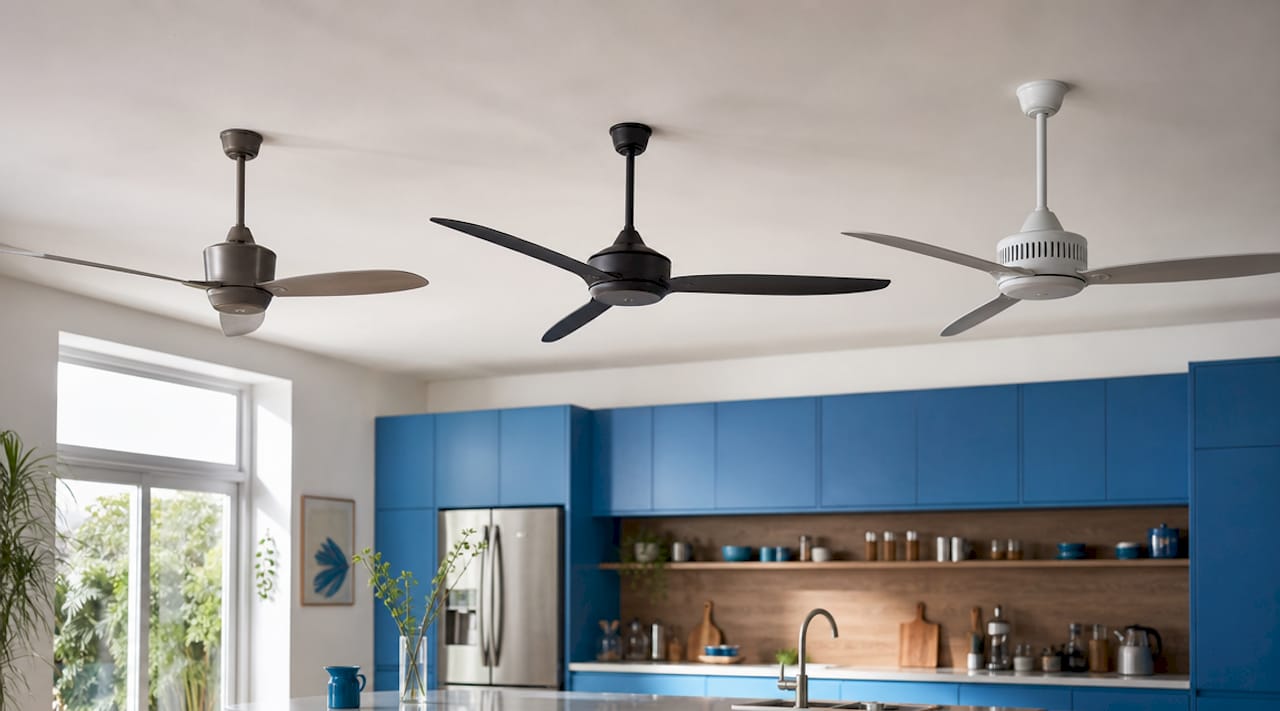
AC induction motors are the oldest and most common technology. They are inexpensive to manufacture, which is why they appear in most budget ceiling fans. The problem is that they waste energy as heat, struggle with precise speed control, and run less efficiently at partial loads. Since most fans spend the majority of their operating time below full speed, this is a significant real-world disadvantage.
EC fans with brushless DC motors use 40% to 70% less energy than AC fans while maintaining efficiency across all speed settings. EC motors combine AC mains compatibility with brushless DC motor efficiency and built-in variable speed control, requiring no external variable frequency drive. That simplifies installation considerably for homeowners who want smart control without an electrician visit.
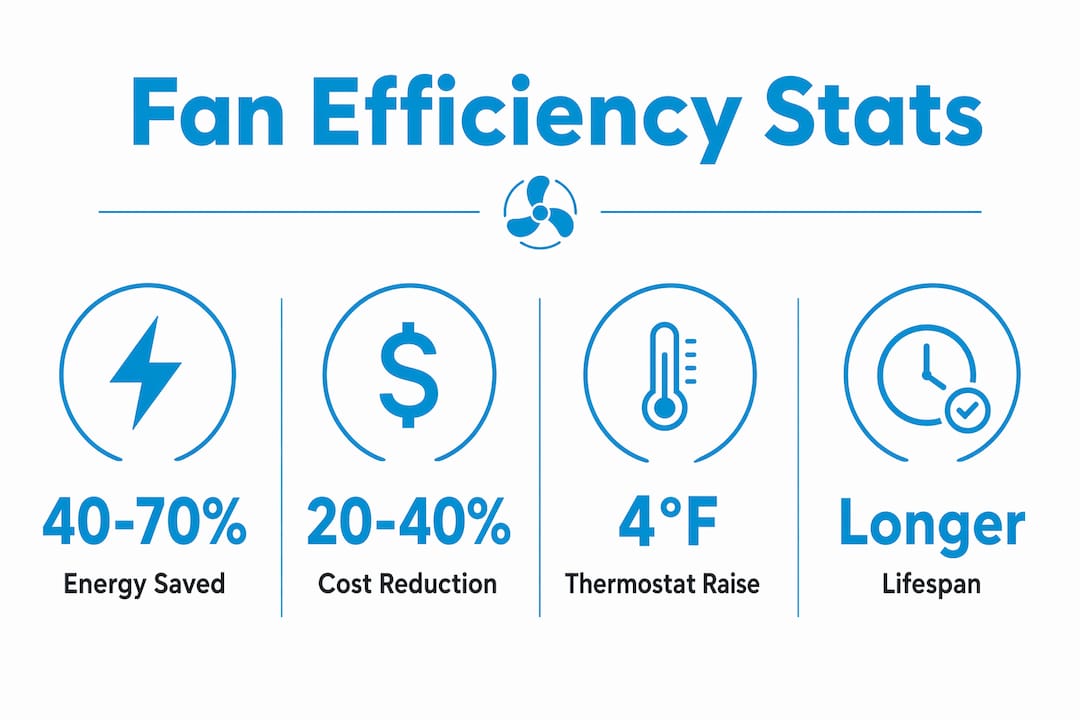
DC and EC motors also offer quieter operation and a longer lifespan than AC induction motors. Quieter operation matters more than most buyers anticipate. A fan running in a bedroom at night at a barely audible level is a fan that actually gets used, and a fan that gets used replaces air conditioning load.
Pro Tip: Check the product listing for “DC motor” or “EC motor” in the specifications. If the listing only says “motor included” or lists wattage without motor type, treat it as an AC motor until proven otherwise.
| Motor type | Energy use | Speed control | Noise level | Lifespan |
|---|---|---|---|---|
| AC induction | Baseline | Limited | Moderate | Standard |
| Brushless DC (BLDC) | 40%–70% less | Precise, multi-speed | Low | Extended |
| EC (Electronically Commutated) | 40%–70% less | Built-in variable | Very low | Extended |
What are the real benefits of energy efficient fans at home?
The most immediate benefit is lower electricity costs. DC motor fans cost 20% to 40% more upfront than standard models but typically recoup that difference within 12 to 18 months through energy savings. After that payback period, every month of operation is net savings. For renters, this math still works because electricity bills are usually the renter’s responsibility.
The second benefit is reduced air conditioning load. The wind chill effect from a ceiling fan allows you to raise your thermostat by about 4°F without any loss of perceived comfort. On a 90°F summer day, that thermostat adjustment can meaningfully reduce your HVAC runtime. Less HVAC runtime means lower bills and less wear on a system that costs thousands of dollars to replace.
Comfort goes beyond temperature. Fans with variable speed controls save more energy because they optimize airflow to actual usage levels rather than running at full speed. A fan running at 40% speed in a bedroom at night uses a fraction of the energy of one locked at high speed, and it creates a gentler, more comfortable airflow. This is where partial load efficiency becomes the deciding factor in real-world performance.
The environmental impact compounds over time. A household running two or three efficient ceiling fans instead of relying solely on central air conditioning reduces its carbon footprint measurably over a decade of use. Energy efficient fans maintain comfort without compromising airflow, primarily by reducing energy waste through smarter design rather than simply moving less air.
- Lower monthly electricity bills with a 12 to 18 month payback period on the price premium
- Thermostat savings of approximately 4°F without comfort loss, reducing HVAC load
- Quieter operation that makes fans practical for bedrooms and home offices
- Longer motor lifespan reducing replacement frequency and long-term cost
- Reduced carbon footprint through lower overall energy consumption
How to choose an energy efficient fan for your home
Start with the CFM per watt figure. Most reputable manufacturers publish this in product specifications. A ceiling fan rated at 75 CFM per watt or higher is performing well. ENERGY STAR certified models consistently hit this range. If a product page does not list CFM per watt, that is itself a signal worth noting.
-
Check for current certification labels. Look for ENERGY STAR certification on the product listing. Given the 2026 recalibration of BEE star ratings, verify the current label rather than relying on older marketing materials or cached product images.
-
Prioritize DC or EC motor technology. These motors deliver the 40% to 70% energy savings that make the efficiency label meaningful. AC motor fans with ENERGY STAR labels exist, but they represent the lower end of the efficiency range.
-
Match fan size to room size. A 52-inch fan suits most standard bedrooms and living rooms up to 400 square feet. Rooms larger than 400 square feet benefit from a 60-inch fan or multiple smaller units. Undersizing a fan forces it to run at higher speeds, reducing efficiency gains.
-
Look for smart controls and variable speed settings. Power consumption follows a cubic relationship to speed, meaning running a fan at 70% speed uses roughly 34% of the energy required at full speed. Smart controls and multi-speed remotes make it easy to run fans at the optimal setting rather than defaulting to high.
-
Factor in integrated LED lighting. Fans with built-in LED fixtures replace a separate light fixture, compounding the energy savings. Look for fans with LED kits rated at 10 watts or less for the light component.
Pro Tip: For renters who cannot install a ceiling fan, look for small room fan options with DC motors and multiple speed settings. These deliver meaningful efficiency gains without any permanent installation.
Key takeaways
Energy efficient ceiling fans are defined by CFM per watt performance, motor technology, and current certification status, and choosing correctly saves most homeowners the price premium within 18 months.
| Point | Details |
|---|---|
| CFM per watt is the core metric | Higher CFM per watt means more air moved per dollar of electricity spent. |
| DC and EC motors lead efficiency | These motor types use 40%–70% less energy than standard AC induction motors. |
| ENERGY STAR delivers proven savings | Certified fans achieve 44%–60% greater efficiency than conventional models. |
| 2026 rating recalibration matters | Always check current certification labels; older star ratings may no longer be accurate. |
| Payback period is short | Most efficient fans recover their price premium through savings within 12 to 18 months. |
Why most buyers still get this wrong
I have spent years watching homeowners walk into a purchase based on wattage alone. They see a fan rated at 18 watts and assume it is efficient. What they miss is that a poorly designed 18-watt fan with weak blade pitch can move less air than a well-engineered 30-watt fan. Efficiency is a ratio, not a single number.
The partial load question is the one I find most underappreciated. Efficiency at partial load is more critical than maximum speed efficiency because fans almost never run at full speed during typical home use. An AC motor fan that looks acceptable on a spec sheet at full speed can be genuinely wasteful at the 50% to 60% speed settings where it actually spends most of its life.
The 2026 certification recalibration is also catching buyers off guard. A fan purchased two years ago with a 5-star BEE rating may now be a 4-star product by current standards. This is not a flaw in the fan. It reflects the fact that the industry has moved forward and the goalposts have shifted. My advice is to treat any certification label older than 12 months with some skepticism and verify against current published standards.
The long-term math on efficient fans is straightforward. You pay more upfront, you get it back within a year and a half, and then you save money every month for the next decade. That is not a complicated investment case. The barrier is usually that buyers focus on the sticker price and not the operating cost. Pairing a programmable thermostat with efficient ceiling fans compounds the savings further, since both systems work together to reduce HVAC runtime.
— Eli
Find your next energy efficient ceiling fan at Wynwoodfans
Wynwoodfans carries a curated selection of ceiling fans built around DC motor technology, ENERGY STAR performance, and designs that work in real homes rather than just showrooms.

The 52" Yonas Ceiling Fan is a strong starting point for most living rooms and bedrooms. It combines coastal-grade construction with high-efficiency performance and is rated for both indoor and outdoor use. For smaller spaces, the 52-inch Captiva LED delivers DC motor efficiency with integrated LED lighting in a clean matte black finish. Every fan in the Wynwoodfans lineup includes full product specifications so you can verify CFM per watt before you buy, not after. Browse the full collection at wynwoodfans.com and filter by motor type, room size, and certification status.
FAQ
What does energy efficient fan mean in simple terms?
An energy efficient fan moves more air per watt of electricity than a standard fan, measured by the CFM per watt ratio. The higher that ratio, the more cooling you get for less money on your electricity bill.
How do I know if a ceiling fan is energy efficient?
Look for an ENERGY STAR certification label and a published CFM per watt figure in the product specifications. Fans rated at 75 CFM per watt or higher and carrying a current ENERGY STAR label meet the standard for genuine efficiency.
Are DC motor fans worth the higher price?
Yes. DC motor fans typically cost 20% to 40% more than AC motor models but recover that difference through energy savings within 12 to 18 months. Over a 10-year lifespan, the total savings are substantial.
Does a ceiling fan actually reduce air conditioning costs?
The wind chill effect from a ceiling fan allows you to raise your thermostat by about 4°F without any loss of perceived comfort, which directly reduces how often your air conditioner runs and how hard it works.
What is the difference between a DC motor and an EC motor in a fan?
Both use brushless DC technology and deliver 40% to 70% energy savings over AC induction motors. EC motors add built-in variable speed control and AC mains compatibility, making them slightly easier to install and control without additional hardware.