

A ceiling medallion fan is an ornamental disc mounted between a ceiling fan’s canopy and the ceiling surface, designed to frame the fixture, cover wiring gaps, and add architectural character to any room. Most homeowners discover medallions only after installing a fan and noticing the bare, unfinished ring around the canopy. That gap is exactly what a medallion solves. Beyond aesthetics, these decorative elements reduce fan noise, conceal electrical boxes, and transform a standard ceiling fan into a design statement. Whether you’re working with a transitional style ceiling fan or a coastal model, a medallion can make the entire fixture look intentional and polished.
What is a ceiling medallion fan and how does it work?
A ceiling medallion is an ornamental, non-structural element that frames a ceiling fan or light fixture, covering imperfections and adding visual weight to the ceiling plane without bearing any load. The medallion sits flat against the ceiling, centered on the fan’s mounting point, and the fan canopy overlaps its inner edge. This creates a layered, finished look that reads as built-in architectural detail rather than an afterthought.
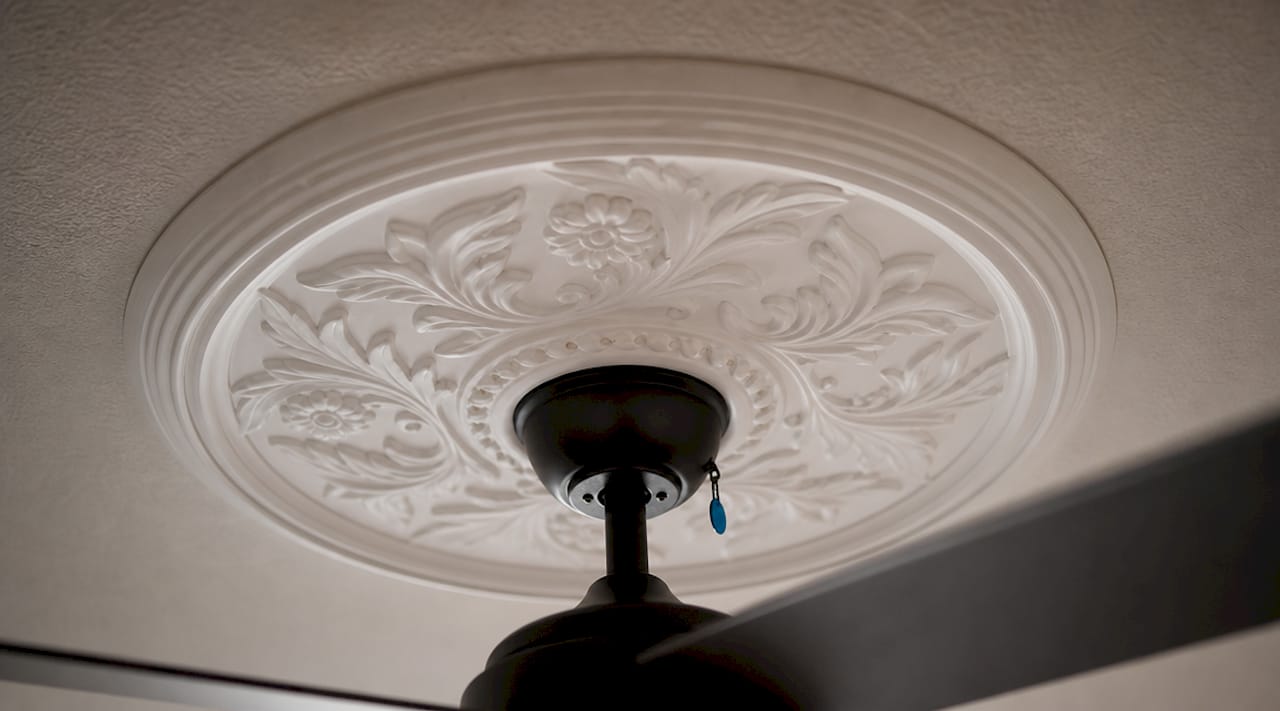
The term “ceiling medallion fan” is an informal phrase homeowners use when searching for this combination. The recognized industry term is simply ceiling medallion, and when paired specifically with a ceiling fan, designers refer to it as a fan medallion or ceiling fan medallion. Understanding both terms helps when shopping, because product listings use them interchangeably.
Medallions are available from retailers including Home Depot, Lowe’s, and specialty millwork suppliers, in diameters ranging from 8 inches to over 36 inches. The right size depends on your fan’s canopy diameter and the room’s proportions, which is covered in detail later in this article.
How do ceiling medallions improve ceiling fan aesthetics and function?
Ceiling medallions do two jobs at once: they make your fan look better, and they make it perform more quietly. The aesthetic improvement is obvious. A medallion adds a finished border around the fan canopy, hiding the raw drywall edge, paint shadows, and any visible wiring or electrical box gaps that standard installations leave behind.
The functional benefit is less obvious but equally real. Medallions reduce noise and vibration by acting as an insulation barrier between the fan canopy and the ceiling surface. This dampening effect is especially noticeable in older homes where ceiling surfaces are uneven and the fan canopy rocks slightly during operation. The medallion fills that micro-gap and absorbs vibration before it translates into audible hum.
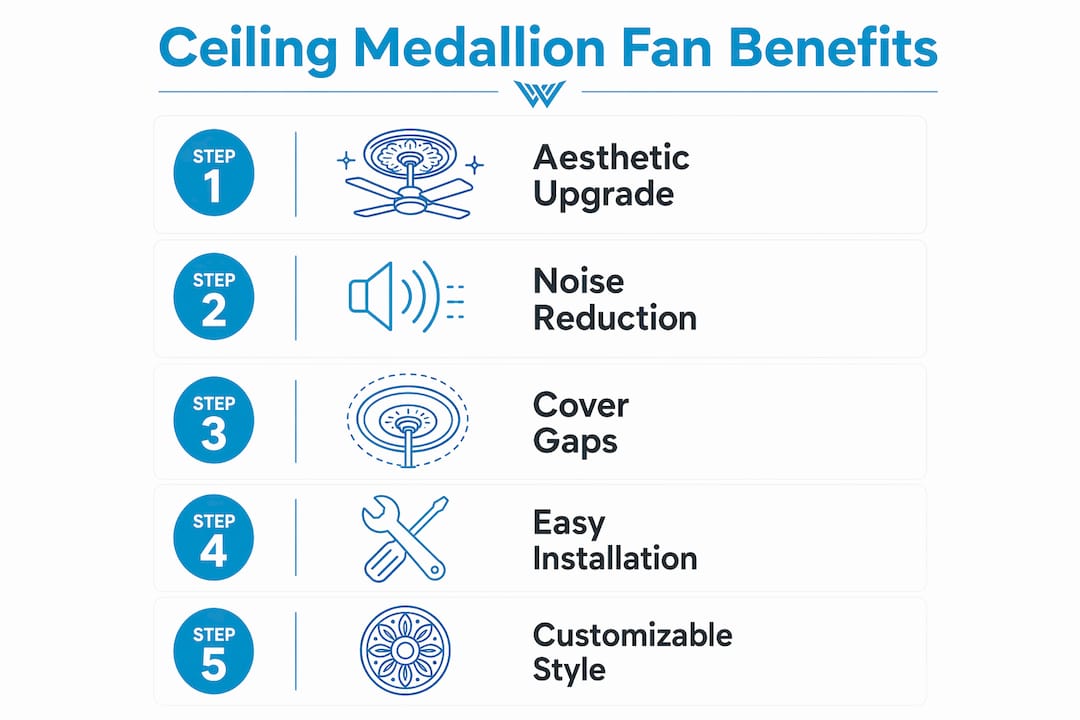
Here is a summary of the core benefits ceiling medallions deliver with ceiling fans:
-
Covers wiring and electrical boxes so the finished installation looks clean from below
-
Hides ceiling imperfections including paint patches, old fixture scars, and drywall repairs
-
Reduces operational noise by cushioning the fan canopy against the ceiling
-
Adds architectural character that makes a standard fan read as a custom fixture
-
Increases perceived ceiling height when painted the same color as the ceiling
Pro Tip: Paint your medallion before installation, not after. Painting it while flat on a workbench gives you full coverage on every carved detail, and you can touch up the ceiling edge separately for a crisp, professional result.
What styles and materials are available for ceiling medallion fans?
The material you choose determines how the medallion looks, how much it weighs, and how easy it is to install. Each material has a distinct trade-off between authenticity, cost, and practicality.
| Material | Weight | Cost | Best For |
|---|---|---|---|
| Polyurethane | Very light | Low to mid | DIY installs, modern and transitional rooms |
| Plaster | Heavy | Mid to high | Historic homes, traditional formal rooms |
| Wood | Medium | Mid | Farmhouse, craftsman, and rustic interiors |
| Metal | Heavy | High | Industrial and contemporary spaces |
Polyurethane medallions dominate the market because they are lightweight, pre-primed, and easy to cut with a standard utility knife. Plaster medallions deliver the most authentic period look but require more careful handling and stronger adhesive. Wood medallions suit farmhouse and craftsman interiors particularly well, while metal options work in industrial loft spaces where the material itself is part of the design language.
Design styles follow a similar split between traditional and contemporary:
-
Classical motifs feature egg-and-dart borders, acanthus leaves, and rosette centers. These suit formal dining rooms, Victorian-era homes, and spaces with crown molding.
-
Minimalist rings use clean concentric circles or simple beveled edges. These work in modern, Scandinavian, and coastal interiors without competing with the fan’s design.
-
Transitional patterns blend geometric shapes with subtle organic detail, making them the most versatile option for rooms that mix old and new elements.
Selecting medallion size proportionate to both the fan canopy and room dimensions is the single most important design decision. A medallion that is too small looks like a washer. One that is too large overwhelms the fan and crowds the ceiling. The general rule: the medallion diameter should be two to four times the fan canopy diameter, and no larger than one-third of the room’s shortest dimension.
Pro Tip: Most medallions come pre-primed in white, but painting them to match your ceiling color creates a subtle, built-in look. Painting them in an accent color creates a bold focal point. Both approaches work. Choose based on whether you want the medallion to blend in or stand out.
How to choose the right ceiling medallion fan for your home
Choosing the right combination of fan and medallion requires thinking about four factors together: room size, ceiling height, decor style, and the fan’s canopy diameter. Getting one wrong throws off the entire look.
-
Measure the fan canopy first. The canopy is the cover plate that hides the mounting bracket. Most residential fans have canopies between 5 and 8 inches in diameter. Your medallion’s center hole must accommodate this canopy, so check the medallion’s inner diameter before purchasing.
-
Scale the medallion to the room. For rooms under 150 square feet, a medallion between 12 and 18 inches works well. Rooms between 150 and 300 square feet suit medallions from 18 to 24 inches. Larger rooms can carry medallions up to 36 inches without looking crowded.
-
Match the medallion style to your decor. A carved acanthus-leaf medallion looks out of place under a sleek modern fan. Pair classical medallions with traditional fans featuring wood blades and antique finishes. Pair clean-ring medallions with contemporary fans in matte black or brushed nickel.
-
Account for ceiling height. In rooms with ceilings under 8 feet, a large ornate medallion can make the space feel compressed. Stick to thinner, lower-profile medallions in tight spaces. Rooms with 9-foot or higher ceilings can carry thicker, more sculptural designs.
-
Consider fan features alongside the medallion. A fan with integrated LED lighting and a remote, like the Kathy Ireland HOME Euclid, pairs naturally with a transitional medallion because both the fan and the medallion share a layered, detailed aesthetic. Matching the finish of the fan canopy to the medallion’s painted color ties the whole assembly together.
Budget matters too. Polyurethane medallions start under $20 and top out around $80 for large ornate designs. Plaster versions run $50 to $200 or more. The medallion itself is a small investment relative to the visual return, but factor in paint, adhesive, and any additional mounting hardware when budgeting.
What is the installation process for ceiling medallion fans?
Installing a ceiling medallion with a ceiling fan is a manageable DIY project, but it requires a specific sequence to get right. Skipping steps leads to sagging medallions, visible gaps, or fans that wobble.
-
Paint the medallion before anything else. Apply your chosen color while the medallion is flat on a work surface. Two coats of latex paint over the factory primer gives full coverage in carved recesses.
-
Cut the center hole if needed. Most medallions come with a small center hole. If your fan canopy is wider than the existing opening, use a utility knife or jigsaw to enlarge it. Test-fit the medallion around the canopy before applying any adhesive.
-
Apply construction adhesive to the back of the medallion. Run a continuous bead around the perimeter and a few interior beads for larger medallions. Press the medallion firmly against the ceiling and hold it in place for 60 seconds.
-
Secure with finishing nails into ceiling joists. Adhesive alone may fail over time, causing sagging. Drive angled brad nails or finishing nails through the medallion and into the ceiling joists for mechanical anchoring. Set the nail heads slightly below the surface and fill with spackling compound.
-
Use longer mounting hardware for the fan. Standard light fixture hardware is often too short to accommodate the added thickness of a medallion. Purchase longer mounting screws or a threaded rod extension before starting the fan installation. This is the most commonly missed step in DIY installs.
-
Caulk the perimeter edge. Apply a thin bead of paintable latex caulk around the outer edge of the medallion where it meets the ceiling. Then smooth the caulk with a baby wipe for a clean, smudge-free finish that looks professionally done.
Critical safety note: A ceiling medallion is purely decorative and carries no structural load. The ceiling fan must be secured independently to a fan-rated electrical box anchored to a ceiling joist or brace. Fixtures must be secured independently of the medallion. Never rely on the medallion to support any part of the fan’s weight.
Key takeaways
A ceiling medallion transforms a standard ceiling fan into a finished architectural feature while reducing noise and covering wiring gaps, making it one of the highest-return upgrades in residential interior design.
| Point | Details |
|---|---|
| Definition and function | A ceiling medallion frames a ceiling fan, covers gaps, and reduces operational noise. |
| Material choice matters | Polyurethane is lightest and easiest to install; plaster delivers the most authentic period look. |
| Size proportionality | Match medallion diameter to fan canopy size and room dimensions for visual harmony. |
| Installation sequence | Paint first, apply adhesive, nail into joists, and always use longer mounting hardware. |
| Structural safety | The medallion is decorative only. The fan must anchor independently to a fan-rated electrical box. |
Why ceiling medallions are the most underrated upgrade in a room
I’ve seen homeowners spend thousands on new fans and then install them against bare drywall, leaving that telltale raw ring around the canopy. It undercuts the entire investment. A $40 polyurethane medallion painted to match the ceiling fixes that problem completely, and most people can install one in under two hours.
What surprises me most is how much the noise reduction matters in practice. I installed a medallion in a bedroom with a fan that had a faint hum at medium speed. After the medallion went up, the hum dropped noticeably. The cushioning effect between the canopy and the ceiling surface is real, not just a marketing claim.
The styling flexibility is also underappreciated. You can paint a medallion the same color as your ceiling for an almost invisible architectural detail, or paint it a contrasting color to make the fan the focal point of the room. That kind of customization at that price point is rare. If you’re exploring ceiling fan styles for your living room, adding a medallion to your planning process from the start will save you a retrofit later.
The one mistake I see repeatedly is skipping the mechanical anchoring step. Adhesive alone holds for a while, then slowly fails, especially in rooms with temperature swings. Drive those finishing nails into the joists. It takes five extra minutes and the medallion will still be perfectly flat a decade from now.
— Eli
Find the right fan to pair with your next medallion

Wynwood Fans carries ceiling fans designed with canopy sizes and finishes that pair naturally with standard medallion diameters. The 52" Yonas Coastal Ceiling Fan in matte white is a strong starting point for anyone working with a minimalist or coastal medallion. Its clean canopy profile works with medallions from 16 to 24 inches without visual conflict. For smaller rooms, the Plumier 22-inch fan pairs well with compact medallions in the 10 to 14-inch range, keeping proportions tight in bathrooms and offices. Browse the full Wynwood Fans collection to find a fan whose canopy size, finish, and style align with the medallion you have in mind.
FAQ
What is a ceiling medallion fan?
A ceiling medallion fan is a ceiling fan paired with a decorative medallion mounted between the fan canopy and the ceiling surface. The medallion covers wiring gaps, hides electrical boxes, and adds architectural detail to the fixture.
What size medallion should I use with my ceiling fan?
The medallion diameter should be two to four times the fan canopy diameter and no larger than one-third of the room’s shortest wall dimension. For most residential fans with 5 to 8-inch canopies, a medallion between 12 and 24 inches is appropriate.
Do ceiling medallions reduce fan noise?
Yes. Ceiling medallions act as an insulation barrier between the fan canopy and the ceiling, dampening vibration and reducing the operational hum that some fans produce at medium and high speeds.
Can I install a ceiling medallion myself?
Most homeowners can install a polyurethane ceiling medallion in under two hours using construction adhesive, finishing nails, and basic tools. The critical steps are painting before installation, using longer mounting hardware for the fan, and anchoring the medallion mechanically into ceiling joists.
Does a ceiling medallion support the ceiling fan’s weight?
No. A ceiling medallion is a purely decorative element and carries no structural load. The fan must be secured independently to a fan-rated electrical box that is anchored to a ceiling joist or approved brace.