

A ceiling fan sized and mounted correctly for your bedroom is the single most effective tool for improving sleep comfort and reducing cooling costs year-round. Most people treat bedroom fans as an afterthought, grabbing whatever fits the budget without checking blade span, motor type, or mounting height. That approach produces fans that run too loud, push too much air, or barely circulate anything at all. This ceiling fan bedroom comfort guide covers everything you need: how to size your fan, where to mount it, which motor to choose, and how to use it in every season for genuine, uninterrupted rest.
How to choose the right ceiling fan size for your bedroom
Fan sizing is the first decision, and it is the one most homeowners get wrong. The rule is straightforward: match blade span to room square footage. Getting this wrong in either direction creates real problems. Oversized fans in small bedrooms create excessive wind and noise, while undersized fans fail to circulate enough air. Neither outcome supports restful sleep.
Use this table as your starting point:
| Room size (sq ft) | Recommended blade span | Mounting type |
|---|---|---|
| Up to 75 | 29–36 inches | Flush mount (hugger) |
| 76–144 | 42–48 inches | Flush or short downrod |
| 145–225 | 52–54 inches | Standard downrod |
| 226–400 | 56–60 inches | Extended downrod |
Measure your bedroom length and width, multiply them together, and find your square footage in the table. A 10 x 12 foot room is 120 square feet, which puts you squarely in the 42 to 48 inch range. A 14 x 16 foot master bedroom at 224 square feet sits right at the top of the medium category, where a 52 inch fan performs best.

One detail most sizing guides skip: blade span alone does not guarantee comfort. Choosing fan size based solely on blade span is insufficient. You must confirm the fan delivers comfortable airflow at low speed without forcing you to run it on high settings. A properly sized fan running on low is quieter and more comfortable than an undersized fan pushed to its limit.
Pro Tip: Measure your room before you shop, not after. Write down the square footage and ceiling height together. Both numbers determine which fan models actually work in your space.
What mounting height and placement do for airflow and comfort
Mounting height shapes how air moves through your bedroom more than most people realize. Blade clearance of at least 7 feet from the floor is the safety minimum. The comfort sweet spot sits between 8 and 9 feet. At that height, the fan moves air across the room in a wide, gentle pattern rather than blasting directly downward onto your bed.
Here is how to handle different ceiling heights:
-
Standard ceilings (8 feet): Use a flush mount or hugger fan. These sit close to the ceiling and keep blades safely above head height without wasting vertical space.
-
Ceilings at 9 to 10 feet: A short downrod of 3 to 6 inches drops the fan to the ideal airflow zone without going too low.
-
Ceilings above 10 feet: Use a longer downrod to bring the fan down toward the 8 to 9 foot target. Leaving a fan mounted flush on a 12 foot ceiling means the blades are too far away to move air effectively at the floor level where you sleep.
-
Vaulted or angled ceilings: Use an angled mounting kit designed for sloped surfaces. Running a standard mount on a vaulted ceiling causes wobble, noise, and uneven airflow.
Placement within the room matters just as much as height. Center the fan directly above the bed or in the center of the room. Either position distributes airflow evenly. Fans pushed toward one wall create uneven circulation and can cause a draft on one side of the bed while leaving the other side stagnant.
Maintain at least 18 inches of clearance between blade tips and any wall or drape. Blades too close to walls create turbulence, which adds noise and reduces efficiency. If your bedroom has curtains near the fan’s path, pull them back or choose a smaller blade span.
Pro Tip: If you are unsure about wiring or mounting on a non-standard ceiling, a licensed electrician handles the job safely and quickly. Proper installation also eliminates the wobble and hum that come from a fan not secured to the right electrical box. A professional ceiling fan installation costs less than replacing a damaged fan or ceiling.
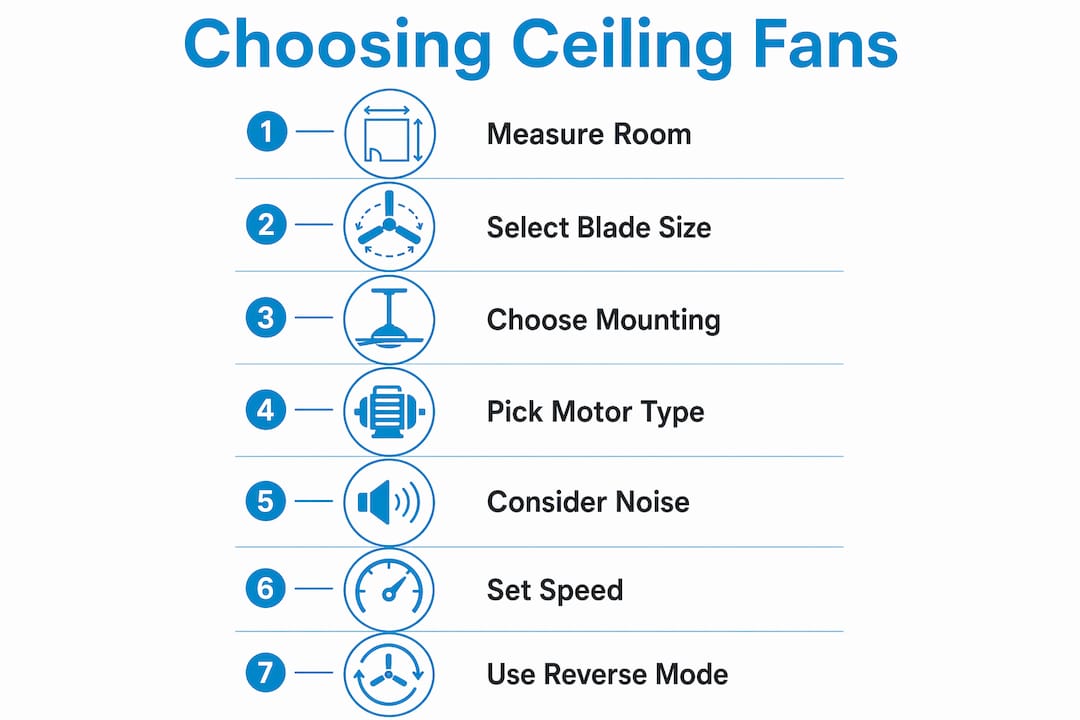
DC motors, blade count, and why quiet operation matters most
Motor type is the specification that separates a good bedroom fan from a great one. DC motor fans are quieter and offer more speed options than older AC designs. That matters in a bedroom because you need precise control at low speeds, not just a powerful top setting. DC motors also use significantly less electricity than AC motors at equivalent airflow levels, which makes them the right choice for a fan running eight or more hours every night.
Noise is measured in decibels, and the threshold for sleep is clear. Fans producing noise below 35 dB at the lowest setting allow uninterrupted sleep. That benchmark rules out many budget AC motor fans, which hum or rattle at low speeds. When comparing fans, look for decibel ratings at the lowest speed setting, not the average or maximum.
Blade count also plays a role in the noise and airflow trade-off:
| Blade count | Airflow | Noise level | Best for |
|---|---|---|---|
| 3 blades | Higher | Louder | Living rooms, open spaces |
| 4 blades | Moderate | Moderate | Versatile rooms |
| 5 blades | Lower | Quieter | Bedrooms, offices |
Five-blade fans tend to be quieter and better suited for bedrooms, while three-blade fans move more air but generate more noise. The trade-off is real, and for a bedroom, quiet wins. You can always run a quieter fan on a slightly higher speed to compensate for lower airflow. You cannot make a noisy fan quiet.
One more point that most buyers overlook: published max RPM data misleads buyers. Performance at the actual sleep speed setting is the better indicator of bedroom suitability. A fan that whispers at speed 1 and 2 is worth more than one with impressive top-speed numbers you will never use at night. For a deeper look at how these motor types compare on efficiency and noise, the AC vs DC motor breakdown from Wynwood Fans covers the technical differences in plain language.
Features and winter tips that make bedroom fans work year-round
A bedroom fan earns its keep in every season when you choose the right features and know how to use them. The reverse mode is the most underused function on most ceiling fans. Reverse rotation on low speed gently pushes warm air that collects near the ceiling back down into the room, evening out temperature and reducing how hard your heating system works. Switch direction in October and switch back in spring.
Lighting is another feature worth thinking through carefully. Warm, dimmable lighting is recommended for bedroom fans because harsh white light disrupts circadian rhythms and makes it harder to wind down before sleep. Look for fans with integrated LED kits rated between 2700K and 3000K color temperature. If you prefer complete darkness, choose a fan without a light kit entirely. Both are valid choices depending on your sleep habits.
Here are the features worth prioritizing on your ceiling fan for bedroom checklist:
-
Remote control or app control: Adjusting fan speed and light from bed without getting up is a genuine quality-of-life improvement, especially at 2 a.m.
-
Multiple speed settings: At least three speeds give you flexibility. DC motor fans often offer five or six, which lets you dial in exactly the right airflow for the temperature.
-
Sleep timer: A timer that shuts the fan off after one or two hours saves energy and prevents overcooling during the night.
-
Reverse mode switch: Required for winter use. Confirm it is accessible via remote, not just a small switch on the motor housing.
-
ENERGY STAR certification: Certified fans use less energy without sacrificing performance. For a fan running every night, the savings add up across a full year.
Smart controls are worth considering if your home already uses a smart home platform like Amazon Alexa or Google Home. Voice control and automated schedules add convenience, but they are not necessary for comfort. The core features above matter more.
Key takeaways
A correctly sized DC motor ceiling fan, mounted at 8 to 9 feet and run at low speed, delivers the quietest and most comfortable airflow for bedroom sleep.
| Point | Details |
|---|---|
| Size to room square footage | Match blade span to room size using a sizing table before purchasing any fan. |
| Mount at 8 to 9 feet | This height produces the widest, most comfortable airflow pattern for sleeping. |
| Choose a DC motor | DC fans run quieter at low speeds and use less energy than AC motor alternatives. |
| Prioritize low-speed noise | A fan quiet below 35 dB at its lowest setting is the right benchmark for bedrooms. |
| Use reverse mode in winter | Switching direction on low speed recirculates warm air and reduces heating costs. |
What I have learned from getting bedroom fans wrong
I have seen the same mistakes repeated in bedroom after bedroom, and the most common one is buying a fan based on how it looks in a product photo rather than how it performs at 11 p.m. on a Tuesday. A fan that looks stunning in a showroom but hums at low speed is a problem you will notice every single night.
The second mistake is ignoring mounting height. Homeowners with 9 foot ceilings often install flush mount fans because they seem simpler. The result is a fan that sits too high to move air effectively at bed level. A short downrod costs almost nothing and makes a measurable difference in how the air actually feels in the room.
The third mistake is trusting top-speed airflow specs. Manufacturers advertise cubic feet per minute at maximum speed because the numbers look impressive. Nobody sleeps with their bedroom fan on maximum. Evaluating fans at the lowest setting is the only test that matters for bedroom use. A fan that is quiet only at a single speed is not truly ideal. Consistent quietness across the two or three lowest speeds is what separates a good bedroom fan from one you will eventually replace.
My honest recommendation: spend the extra money on a DC motor fan with five blades and a remote. The upfront cost is higher, but the nightly experience is noticeably better. You can learn more about energy-efficient fan options to understand where the long-term savings come from.
— Eli
Find the right bedroom fan from Wynwood Fans
Wynwood Fans designs ceiling fans built around the principles in this guide: quiet DC motors, multiple speed settings, dimmable LED lighting, and remote controls sized for real bedrooms.

The 52" Yonas Ceiling Fan is a coastal-grade option built for medium to large bedrooms, delivering sleep-friendly airflow with a clean, modern profile. For bedrooms that need a quiet DC motor with dimmable light and remote control in one package, the 52in CAPTIVA LED fan covers all the bases. If your bedroom has a low ceiling or a compact footprint, the 22in Plumier hugger fan fits flush and keeps blades safely above head height. Every model ships with the specs you need to match it to your room before you buy.
FAQ
What size ceiling fan does a bedroom need?
Match blade span to room square footage: 42 to 48 inches for rooms up to 144 square feet, and 52 to 54 inches for rooms up to 225 square feet. Precise sizing prevents the excessive wind of an oversized fan and the poor circulation of an undersized one.
How high should a bedroom ceiling fan be mounted?
Blades should sit at least 7 feet above the floor for safety, with 8 to 9 feet being the optimal height for airflow and comfort. Use a downrod on ceilings above 8 feet to reach that target zone.
Are DC motor fans worth it for bedrooms?
Yes. DC motors run quieter and offer more speed settings than AC motors, which makes them significantly better for bedroom use where low-speed quiet operation is the priority.
What noise level is acceptable for a bedroom ceiling fan?
Any fan producing noise below 35 dB at its lowest setting is considered suitable for sleep. Check that the fan maintains that level across its two or three lowest speeds, not just the minimum.
Should I use my ceiling fan in winter?
Yes. Switch the fan to reverse mode and run it on low speed. This recirculates warm air that collects near the ceiling, evening out room temperature and reducing how often your heating system cycles on.